

Top 10 Instagram Aesthetic AI Prompts for Men’s Cohesive and Visually Pleasing Feeds
A cohesive Instagram feed for a man does not happen by accident. It comes from repeating a small set of visual decisions until they read as a signature: one lens, one lighting philosophy, one way of standing. This collection of ten prompts builds that signature out of full-body shots, tailored clothing, and locations that range from a rain-slicked cyberpunk alley to a grand antique library.
Each prompt in the set is written as a single, complete image description, so you are not stitching fragments together. You paste one block, upload a reference, and the model handles pose, wardrobe, and light. The trick is understanding what each block is really controlling, because that is what lets you keep ten posts looking like one feed instead of ten unrelated experiments.
What this men's feed prompt collection is asking for
Every card in this set follows the same grammar: a full-body male subject, a specified garment stack, a described location, a named light condition, and a technical tail of camera and rendering terms. That repetition is the point. It is what makes ten different scenes feel like ten frames from one shoot. The differences live in the wardrobe, the environment, and the emotional temperature of the light, not in the structure of the sentence.
- A full-body framing that includes shoes and ground contact, so posture and footwear both matter
- Tailored clothing named down to fabric and color, such as a dark grey suit with a black turtleneck or a dark tweed three-piece suit
- A specific location with physical texture, from a glass-paneled skyscraper balcony to rain-slicked pavement in a neon alley
- A named light source, including a sharp beam cutting across a dark space, golden hour on a marina pier, or low-key glow from a distant streetlight
- An expression and hand position, such as hands clasped in front, arms crossed, or one hand in a pocket
- A rendering tail with ultra-realistic skin texture, 8K resolution, HDR, global illumination, 85mm lens, and f1.8
The shared scene across these ten cards
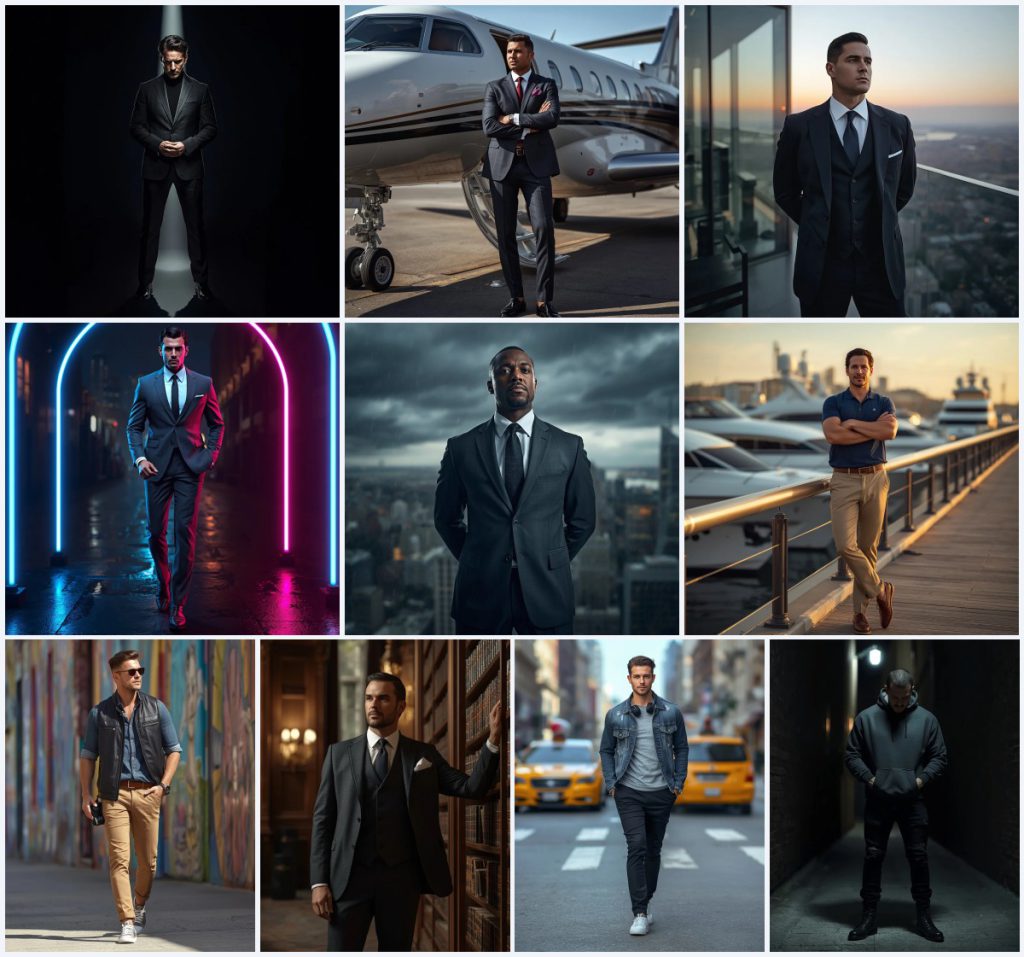
The set moves a single archetype through ten environments. In one card he is "standing directly within a dramatic, sharp beam of light cutting across a dark, abstract space." In another he is "casually yet commandingly positioned beside a sleek, private executive jet on a runway." Then he is on a marina pier at sunset, then "mid-stride, stepping through a futuristic neon archway in a cyberpunk-inspired city alley at night."
The wardrobe shifts with the setting but never breaks character. A "custom-tailored dark charcoal grey suit" appears beside the jet, a "premium navy blue polo shirt, tailored beige chinos, and stylish boat shoes" appear at the marina, and a "simple, dark grey hoodie, distressed black jeans, and classic combat boots" close the set in a dark alley. The through-line is composure: hands clasped, arms crossed, gaze fixed forward or into the distance.
Why this collection works for a cohesive grid
A grid looks intentional when the viewer can predict the framing without predicting the picture. This set delivers that.
- The full-body shot is repeated in every card, so your profile grid has one consistent crop rhythm instead of a mix of selfies, close-ups, and landscapes
- The 85mm f1.8 language is repeated in every card, which keeps the compression, background blur, and subject separation visually consistent across posts
- The emotional register stays in one lane, confident and composed, so a suit by a jet and a hoodie in an alley still read as the same person
Three style directions inside this set
Three style lanes are available here, and each one stays inside the prompt rather than pulling the image somewhere else. Pick one lane and repeat it for a week of posts, or rotate slowly so the feed shifts mood without breaking cohesion.
The corporate power lane leans on tailored suits, glass, steel, and even daylight. The urban night lane leans on neon, rain-slicked pavement, and high-contrast color. The quiet intensity lane leans on low-key light, brick, hoodies, and shadow. All three share the same full-body framing and the same 85mm f1.8 tail, which is what keeps them from looking like three different accounts.
- Corporate power: A dark charcoal grey suit beside a private executive jet under bright, even daylight, where "the polished metal of the jet provides a luxurious, reflective backdrop" and the tailoring carries the authority.
- Urban night: A charcoal grey suit mid-stride through a neon archway, where "electric blue and magenta" light creates sharp highlights and deep, moody shadows on rain-slicked pavement.
- Quiet intensity: A dark grey hoodie and combat boots in an atmospheric alley, where "cinematic, low-key lighting creates deep shadows and subtle highlights" and the mood is solitude rather than spectacle.
How to run these prompts without losing the look
The workflow is short, but the order matters. Generate first, inspect second, adjust third. Most disappointing results come from skipping the inspection step and generating a second image before diagnosing what went wrong in the first one.
- Copy the prompt. Take the full text of one card exactly as written, including the camera tail, and paste it into your image tool without trimming the rendering terms.
- Upload a reference. Add a clear, well-lit photo of the subject, ideally a full-body shot in simple clothing so the model reads body shape and proportions rather than the outfit.
- Generate. Run the prompt and produce two or three variations at once, because lighting-heavy prompts vary a lot between seeds.
- Check hands. Zoom in on clasped hands, crossed arms, and pockets, since these are the poses most likely to produce fused or extra fingers.
- Check face. Confirm the expression matches the card, intense and focused, relaxed yet discerning, or brooding and contemplative, and that the face is not over-smoothed.
- Check the main object. Verify the hero element is intact, whether that is the beam of light, the executive jet, the neon archway, or the towering bookshelf, and that it reads as described rather than as generic background.
Choosing the reference photo
The reference photo does more work than most people expect. These prompts describe wardrobe and location in detail, but they rely on your upload for bone structure, height, and natural posture. A weak reference will produce a technically sharp image of someone who is not quite you.
- Use a full-body shot with visible shoes and a neutral stance, since every card in this set is a full-body composition
- Shoot in even, diffuse light without a strong colored cast, because the prompt supplies its own lighting and a warm indoor cast will fight it
- Wear simple, fitted clothing so the model reads your silhouette instead of the outfit you already have on
Which tool to use for which card
All four tools can run these prompts, but they differ in how much they preserve your reference and how much they reinterpret it. Match the tool to the card and to how close a likeness you need.
| Tool | Access | Typical realism | Useful here for |
|---|---|---|---|
| ChatGPT | Web and mobile, paid tiers for image generation | Good to very good, strong at instruction following | Rewriting a card's wardrobe while keeping the "85mm lens, f1.8" tail intact |
| Google Gemini | Web and mobile, generous free tier | Good, improving quickly on full-body anatomy | Fast iteration on the marina pier card, where "golden hour light casts a warm, soft glow" |
| Leonardo AI | Web, free credits plus paid plans | Very good, strong texture and material rendering | The grand library card, where "warm, ambient light from brass lamps" needs believable wood and fabric |
| Midjourney | Web and Discord, paid subscription | Excellent, best cinematic light and mood | The neon archway card, where "electric blue and magenta" light needs real color separation |
Small adjustments that protect the look
These prompts are detailed enough that you should resist rewriting them. Instead, make surgical changes that keep the structure and swap one variable at a time.
- Keep the 85mm f1.8 tail on every card, even if you change wardrobe or location, because that single line is doing most of the cohesion work across the feed
- When you swap the suit for the "dark grey hoodie, distressed black jeans, and classic combat boots" card, also swap the light description, since a tailored suit under low-key alley light reads as a costume mismatch
- If the "glass-paneled balcony" card keeps producing a flat city, add one clause about the dawn sky rather than deleting the balcony, which is the anchor of that composition
Common failures and how to correct them
Most problems with this set fall into four buckets. Each one has a specific edit rather than a full rewrite.
| Issue | What to change |
|---|---|
| Face looks plasticky and over-smoothed | Increase the emphasis on "ultra-realistic skin texture" and lower any beauty or retouch setting in your tool |
| Hands are fused or have extra fingers | Switch to a card with a simpler pose, such as "hands clasped loosely behind his back," or regenerate with a different seed |
| The beam of light is soft and diffuse instead of sharp | Reinforce the word sharp and specify hard-edged shadows, since the card depends on "sharp lines and deep shadows" |
| The suit reads as cheap or shiny | Name the fabric again in your edit and add matte wool, because "meticulously tailored" alone does not always control the material finish |
Frequently Asked Questions
Can I use one reference photo for all ten prompts in this collection?
Yes, and that is the recommended approach. Because every card is a full-body composition with the same 85mm f1.8 tail, a single clean full-body reference will keep your face and proportions consistent across the whole grid.
Do I need to change the wardrobe text if my reference photo already shows different clothes?
You should keep the wardrobe text and let the prompt override the reference. The clothing descriptions, such as the dark tweed three-piece suit or the premium navy blue polo shirt, are what set the tone of each card, so removing them flattens the whole set.
Which card in this set is hardest to get right on the first try?
The neon archway card. It combines a mid-stride pose, colored light on dark fabric, and a complex background of rain-slicked pavement and distant skyscrapers, so expect to generate several variations before the color and the pose both land.
Conclusion
This collection is less about ten separate images and more about one visual system applied ten times. The full-body framing, the tailored wardrobe language, the named light source, and the 85mm f1.8 tail are the constants. Everything else, the jet, the marina, the library, the alley, is the variable that keeps the feed from looking repetitive. Pick one style lane, run it consistently, and inspect hands, face, and the hero object before you post anything.